
← All work

Standing up a new digital government agency.

A new agency built to deliver private-sector-quality experience for every digital government service in Oklahoma.

Jump to results ↓
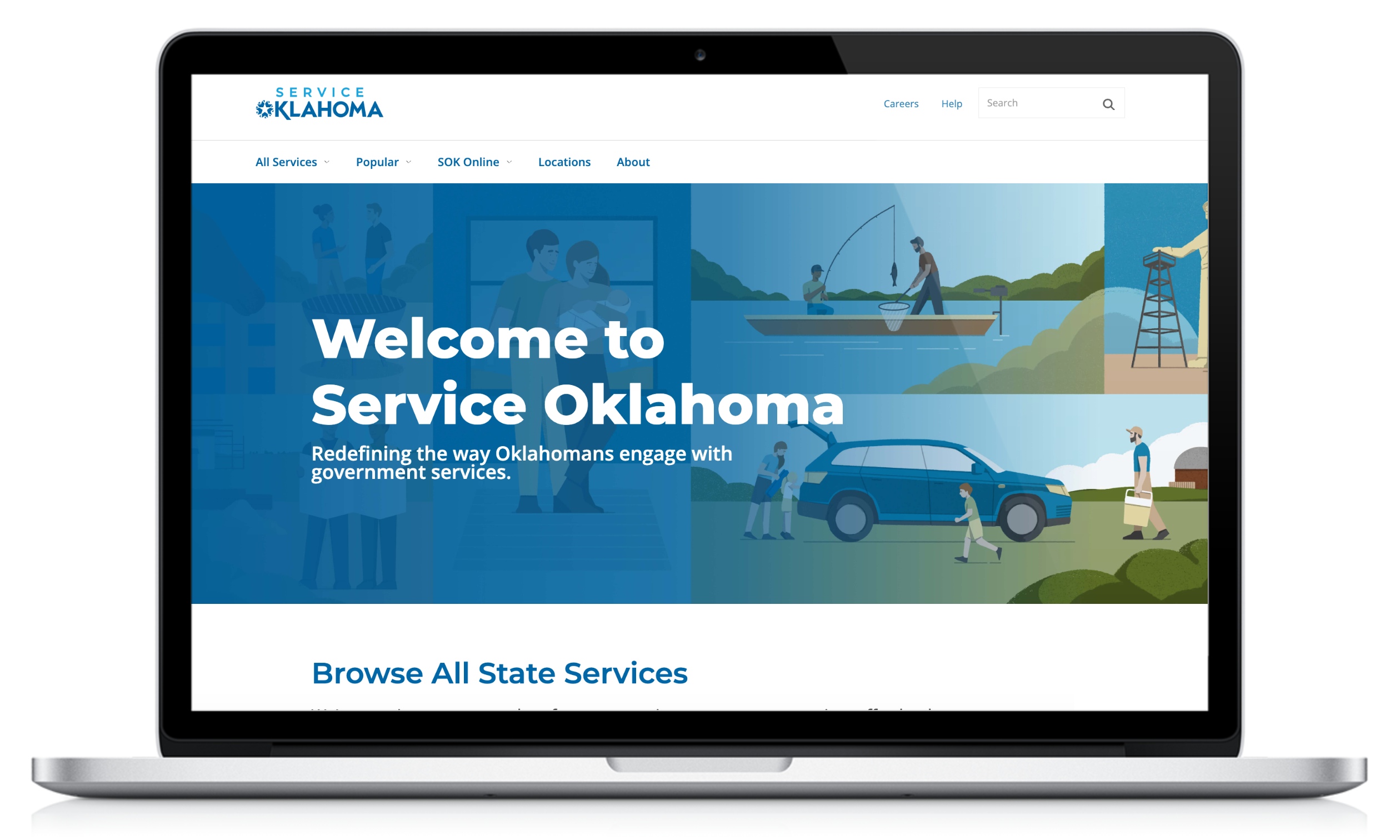
Service Oklahoma homepage shown on a MacBook
01The Service Oklahoma digital hub at oklahoma.gov/service — one front door for every state service.
01The objective

The State of Oklahoma sought to stand up an entirely new digital government agency that would be responsible for the resident experience across every service in the state.

The brief was twofold: deliver a best-in-class customer experience on par with leading private-sector companies, and drive significant efficiency gains across operations.

We identified two government services as our starting points for transformation: disability placard applications (fully manual at the time), and driver’s license renewals (a disjointed and lengthy process).
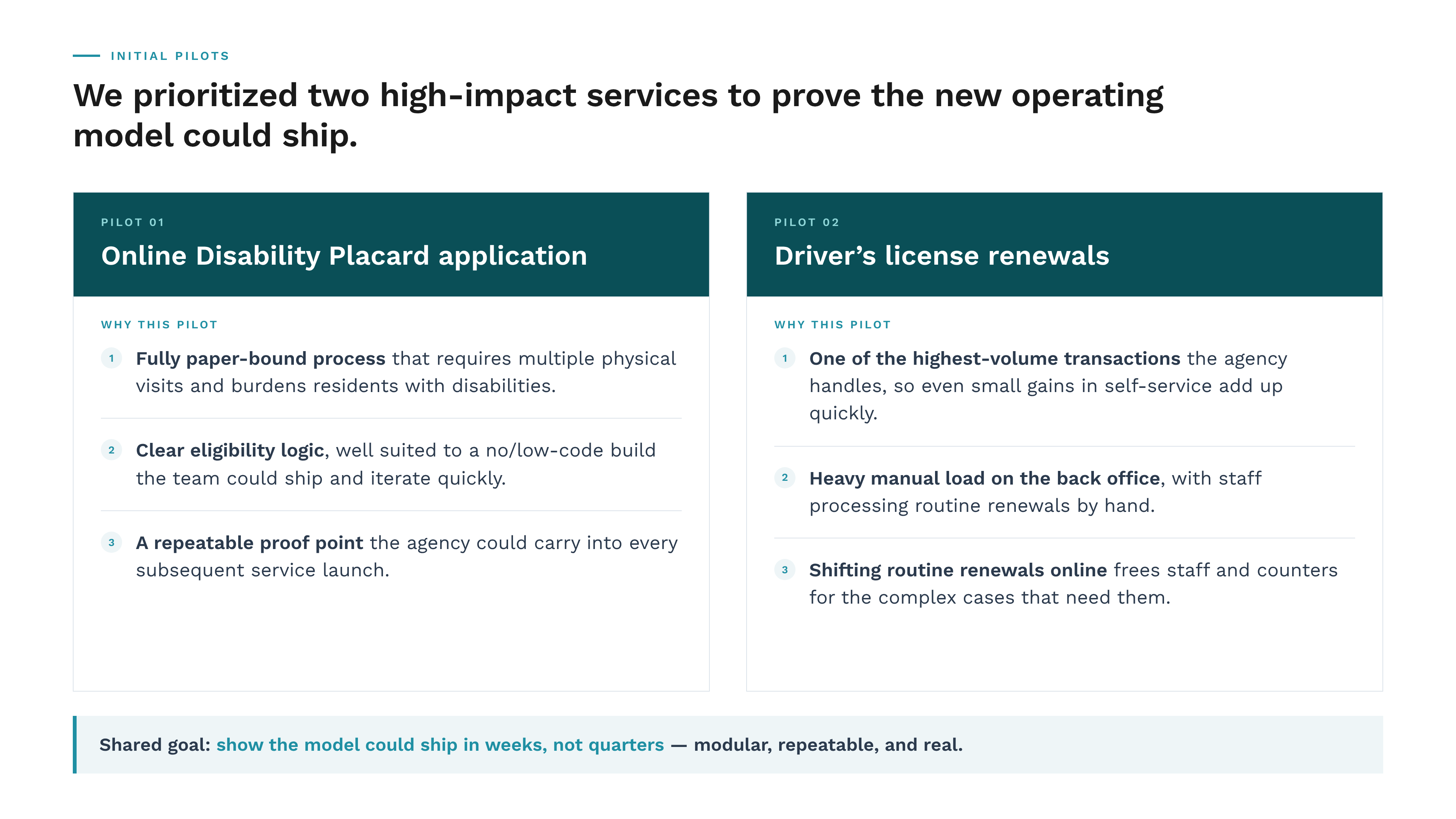
Initial pilots: the Online Disability Placard application (a fully paper-bound process that burdened residents with disabilities, with clear eligibility logic and a repeatable proof point) and driver's license renewals (one of the highest-volume transactions, with a heavy manual back-office load). Shared goal: show the model could ship in weeks, not quarters.
02Initial pilots — chosen for volume and back-office load — enabled us to test and learn how Service Oklahoma might design and scale newly transformed services.

02What we did

Over a 3-month sprint, we identified two high-impact pilots — disability placard applications and driver’s license renewals — and took discovery into the field, observing how residents, government employees, and doctors’ offices moved through each service today. We translated those findings into future-state vision maps and digital prototypes.
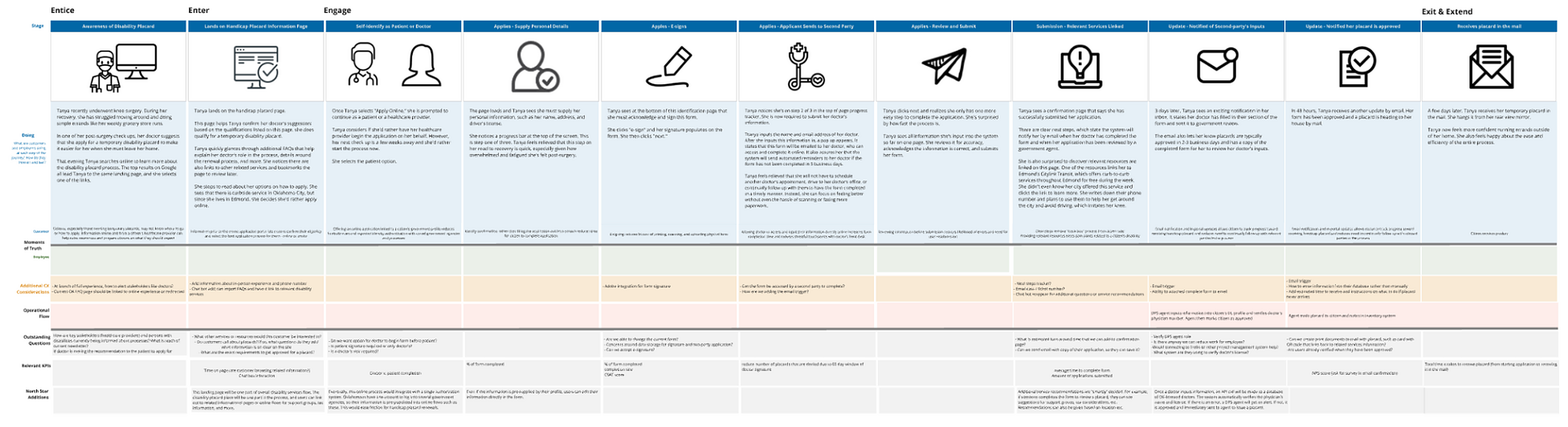
Vision experience journey map for the online disability placard application, following a resident from awareness through application, e-signature, second-party verification, submission, and receiving the placard in the mail — with what she is doing, moments of truth, operational flow, open questions, KPIs, and north-star additions at each stage.
03Vision experience — Mapping the transformation from manual disability placard applications to digital servicing.

From there, we tested and learned in rapid loops, ultimately launching a new government site and two transformed services within three months. Our low-code methodology ensures that the experience can evolve in real-time when Service Oklahoma receives feedback, without the typical burdens of a complex government tech stack.

Throughout the process, we trained our Service Oklahoma counterparts on how to run innovation sprints so that they can keep designing and launching new services in perpetuity.
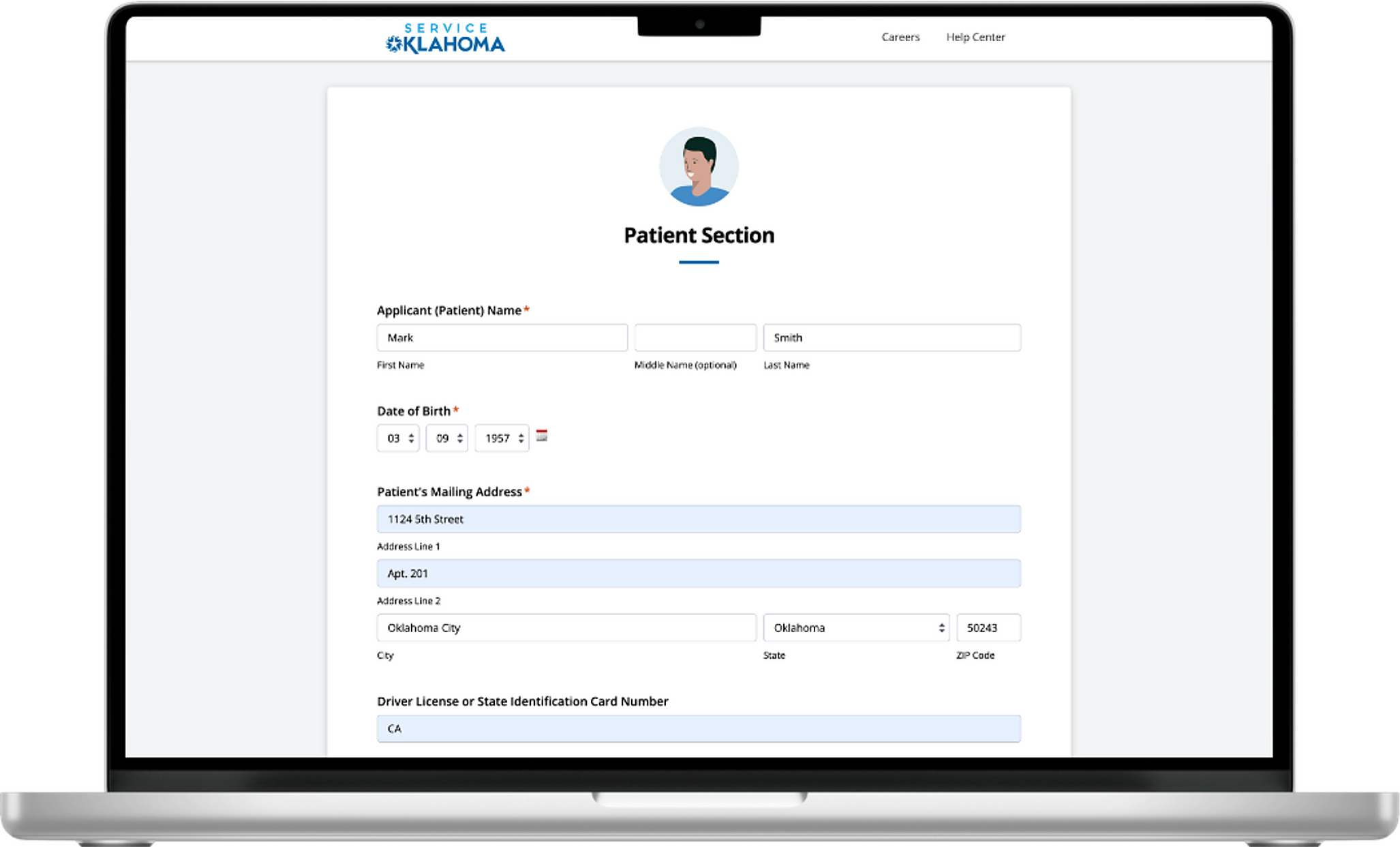
The digital disability placard application MVP on a laptop, showing the Patient Section of the Service Oklahoma form.
04Our MVP — We tested multiple iterations of a digital disability placard application that patients could fill out at home or with their doctor, rather than mailing a paper form.

03My role
  • Assessed the highest-impact government services to leverage for our pilots
  • Oversaw all qualitative research with citizens and ecosystem stakeholders, including government officials, back-office workers, and doctors/medical office staff (for placards)
  • Created future vision experience maps for our two MVPs
  • Led content strategy and co-created digital prototypes for placard applications and license renewals
  • Led testing throughout our 3-month sprint to ensure our outputs reflected user feedback
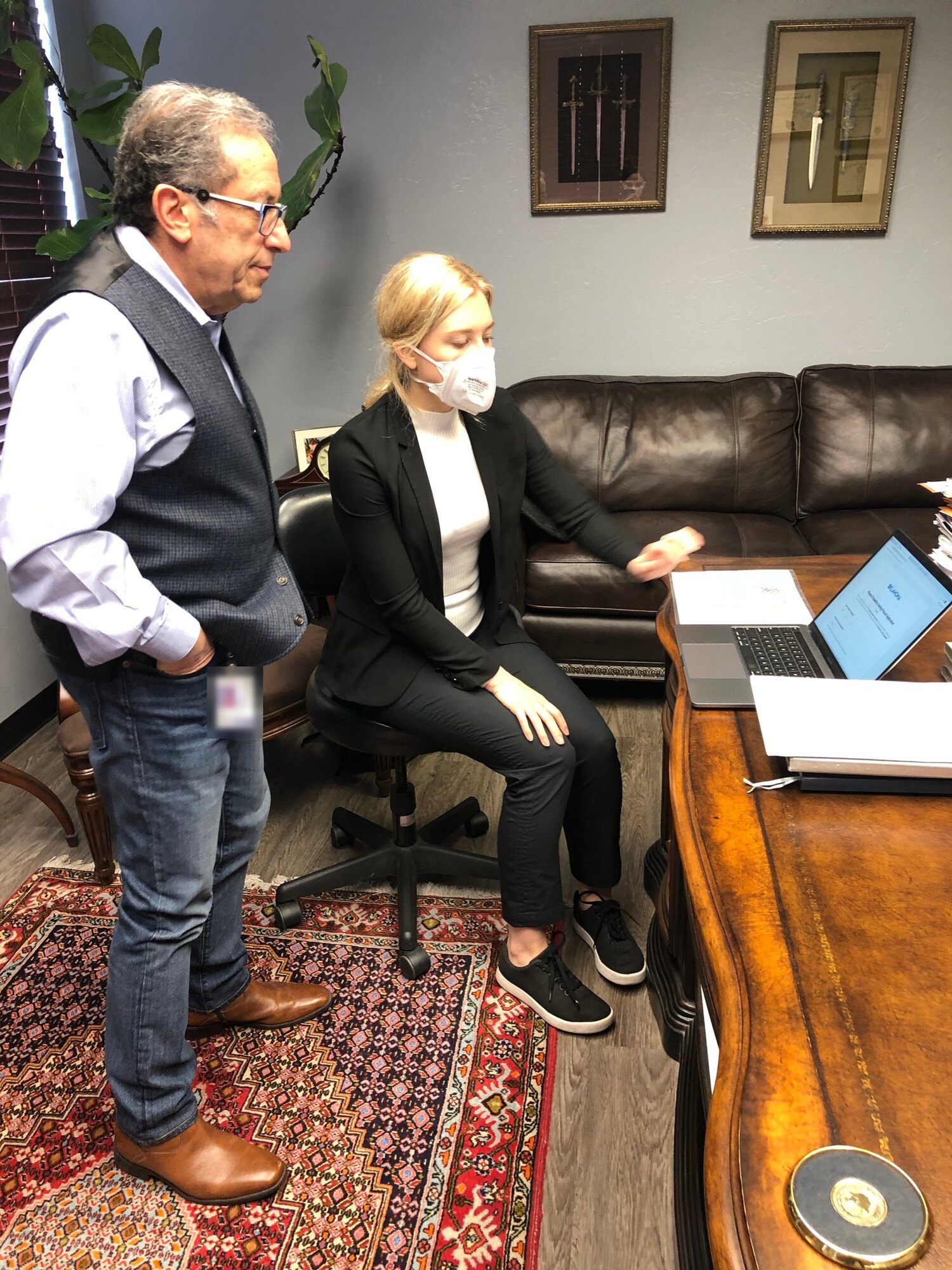
  • Developed a webinar to train doctors across Oklahoma on the new disability placard application process, and conducted on-site training with our PM
A doctor being walked through the new online disability placard application on a laptop in his office.
05Training doctors — We visited several offices to train early adopters on integrating the new placard application with their medical practices.

04The solution

Service Oklahoma launched as a new, omni-channel agency built to make government services easier for every Oklahoman — pairing a single digital front door with in-person and phone support. Using low-code tools and a standardized architecture, we shipped disability placard applications and driver’s license renewals as pilots, and refined them with public feedback.

The first, a fully digital placard application built with support from the State Medical Board, let residents apply from home or their doctor’s office — cutting wait times by 80% and eliminating 60% of the steps required.

Service Oklahoma has continued to roll out primary services since its launch, using the baseline of our work together as a framework. To learn more, check out Service Oklahoma here.

Results

Within two years of stand-up
Self-service 38%

Increase in customer self-service across all services.

Operating cost ~30%

Cost reduction through operational efficiency across launched digital pilots.

Increased speed 80%

Reduction in wait times for disability placards.

Industry recognition 2x

NASCA ‘Innovation in State Government’ award winner.

06The agency’s launch promo, courtesy of Service Oklahoma; ‘Skip a trip, visit Service Oklahoma instead.’